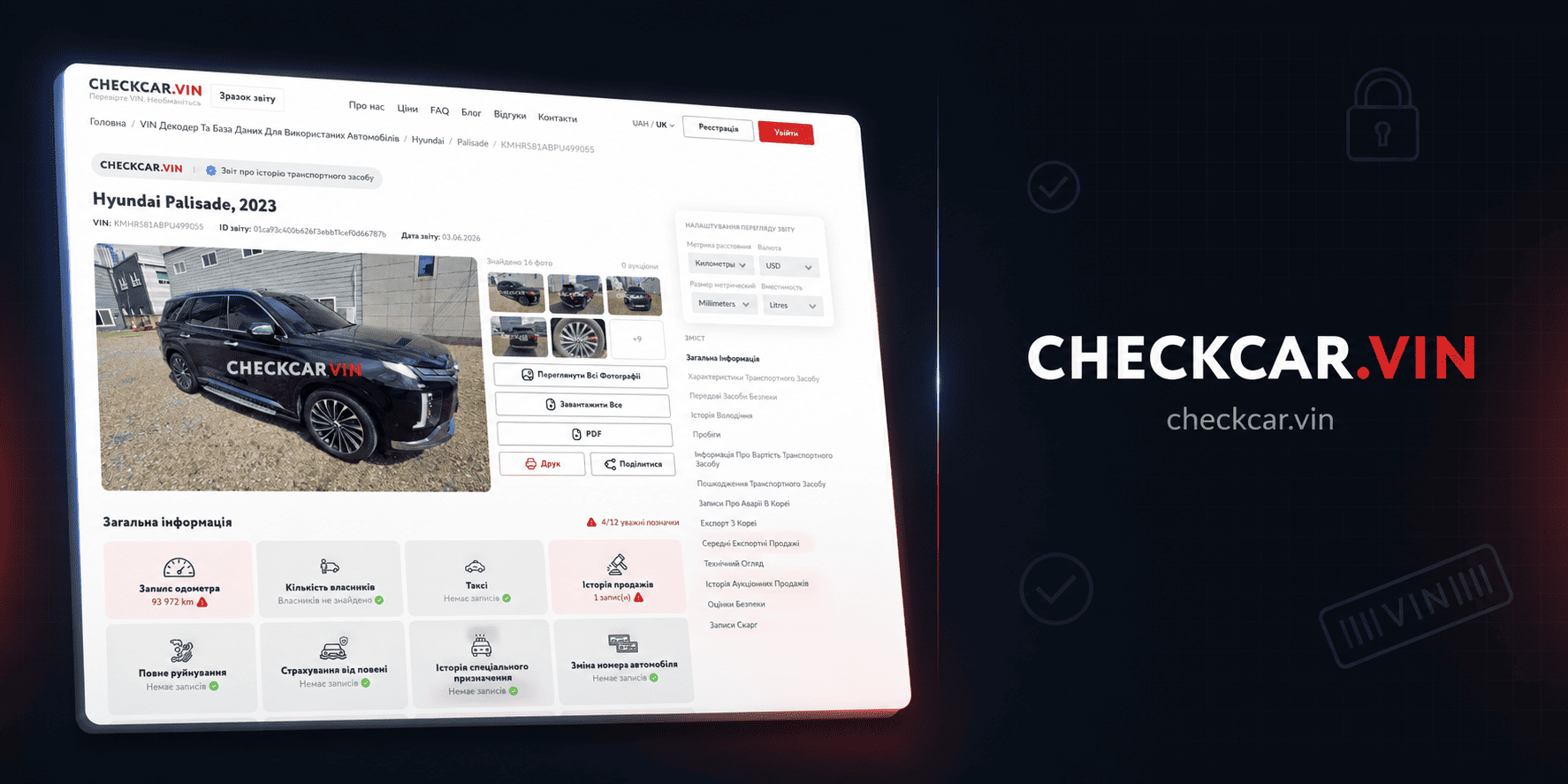
What does an auction vehicle have in common with a beautiful house facade? It may hide an imperfect history that the seller would prefer not to disclose. Exterior detailing can conceal signs of intensive use (odometer rollback), restoration after serious damage, and by appearance alone you would never guess that the vehicle, for example, is pledged as collateral to a bank. Check VIN is a simple way to save money and time, and to make sure you are making the right choice even at the vehicle selection stage.
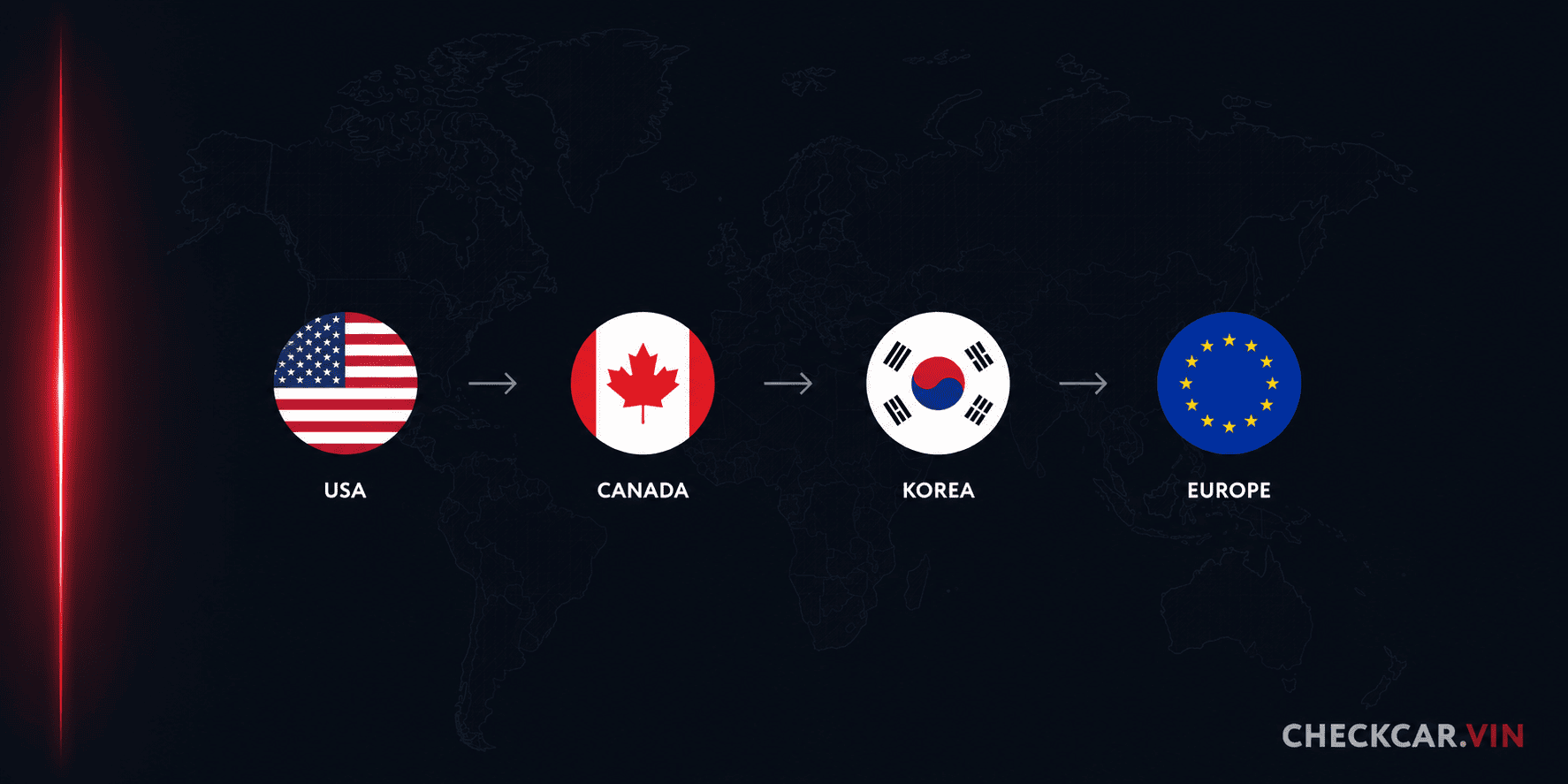
Online auctions are the primary channel for purchasing used cars from the USA, Korea, Canada, and Europe. International Auction PLC.auction is one such platform. Users find a lot, place a bid, win, pay, and wait for delivery. The entire process takes weeks or even months. During all this time, you have no access to the vehicle—only catalog photos and the seller’s description. Therefore, confidence in the safety of the transaction can only be provided by an effective and comprehensive vehicle history check by VIN number, which is offered by the checkcar.vin service. In this review, you will learn how the service works, what data can be found in the report, checkcar.vin pricing, and real service reviews.
Vehicle Purchase Markets
Vehicles at used car auctions are sold across four major markets. Each has its own characteristics and risks. Let’s examine each one.
USA
The largest auction vehicle market. The biggest American auctions are Copart and IAAI, where tens of thousands of lots are listed every day. Vehicles are sold after insurance claims, lease returns, with mileage and without.
Main risks:
- Hidden accident damage that is not visible in standard photographs. Auctions provide only general images that do not allow assessment of structural deformation or wiring condition.
- Flood damage. After hurricanes and floods in the United States, thousands of water-damaged vehicles end up at auctions. They are dried and cleaned, after which they may appear perfectly normal. After a short period of use, electrical problems begin, contacts corrode, and airbags may fail.
- Salvage status. The insurance company determined that restoring the vehicle was economically impractical. Such a vehicle cannot be operated without repairs and title re-registration. In some countries, importing Salvage vehicles is prohibited.
- Rebuilt status. The vehicle was restored after receiving a Salvage title and passed inspection. It can be driven, but its value is 30–50% lower than that of a comparable clean vehicle. This can be difficult to explain to the next buyer when reselling.
- Odometer rollback. Less common than in Korea, but it still occurs. A VIN report will reveal discrepancies.
What to check in the report when buying American vehicles: title status, auction history (whether the vehicle was previously sold with different damage), actual mileage based on maintenance records, insurance records, etc.
Canada
The market is similar to the American one. The same auctions and insurance companies are involved. However, registration requirements are stricter, so vehicles from Canada generally have less damage. Odometer rollback and hidden accident damage remain risks.
A special feature of Canadian vehicles is that many come with a “winter package”—heated seats, heated steering wheel, and heated washer nozzles. The downside is corrosion caused by road chemicals, which is less common on vehicles from the southern United States.
Korea
A huge selection of nearly new Kia, Hyundai, and Genesis vehicles. Often equipped with factory-installed LPG systems. Mileage is usually low—30,000–50,000 km. Prices are attractive—one and a half to two times lower than comparable European vehicles.
Odometer rollback is a common occurrence in the Korean market. Mechanics at auctions and dealerships reduce odometer readings before sale. A vehicle with an actual mileage of 120,000 km may be sold as one with 50,000 km. The difference in price and condition is significant.
What to check when buying Korean vehicles:
- Discrepancies between odometer readings in different auction records.
- Number of owners. If the vehicle has changed hands frequently, there are likely underlying issues.
- Accident records. Insurance claims are recorded in Korea, but not always.
Also note that Korean LPG vehicles require additional certification when imported into some countries. The report will show the original factory configuration.
Europe
Vehicles from Germany, France, the Netherlands, Poland, and the Czech Republic. Advantages include fast delivery, simple customs clearance, and fewer documentation issues. Delivery from Germany typically takes 7–18 days, while delivery from Poland usually takes 3–14 days.
Disadvantages:
- European vehicles generally have higher mileage than Korean and American auction lots. 150,000–200,000 km is normal for a 5–7-year-old European vehicle.
- Risk of hidden accident damage. Not all insurance claims are recorded in a centralized European database. If repairs were performed without insurance involvement, there may be no record.
- Liens or legal seizure. In some countries, banks do not register liens in a central database. A seller may sell a vehicle that legally belongs to the bank.
What to check when buying European vehicles: number of owners (frequent ownership changes are suspicious), liens and encumbrances, open recall campaigns, and mileage.
What Is CheckCar.VIN
Checkcar.vin is an online vehicle history checking service based on VIN numbers. It works with vehicles from the USA, Korea, Canada, and Europe. Simply enter the 17-character VIN, and within seconds you receive a structured report.
Data sources:
- Carfax – the largest vehicle history database in North America. It contains information about mileage, accidents, number of owners, and service history.
- AutoCheck – a competitor to Carfax used by Copart and IAAI auctions. It provides additional information about title status and auction sales.
- NMVTIS – a government system operated by the U.S. Department of Justice and created to combat vehicle sales fraud. Insurance companies, auctions, and salvage organizations are required to submit title status information to this system. It is not a commercial aggregator but an official database that receives data from insurance payouts, auctions, and salvage operators. Hiding information within it is virtually impossible. If a vehicle has ever received a Salvage title, that record remains in NMVTIS permanently.
- Window Sticker – factory configuration data for vehicles from the United States. Information about the powertrain, transmission, options, color, and manufacturer’s suggested retail price.
- Auction systems – contain sales history, condition assessments, and lot numbers.
- Other sources that checkcar.vin keeps confidential.
Checkcar.vin uses NMVTIS as one of its sources, which increases report reliability. Unlike competitors that rely primarily on commercial databases, checkcar.vin utilizes data from numerous government sources.
What Is Included in the Report
A checkcar.vin report contains several sections. Each of them provides useful information.
Odometer Mileage
Records from auction and insurance sources are displayed with dates and odometer readings. These records allow you to track mileage progression and identify discrepancies or illogical decreases in mileage.
Odometer rollback is one of the most common types of fraud when selling vehicles from the USA and Korea. The report shows not only discrepancies but also the date of the last recorded mileage. If the last record was made two years ago and the mileage has barely increased since then, that is also suspicious.
For vehicles from the United States, where odometer controls are stricter, discrepancies are less common. However, there are cases where mileage is rolled back after the vehicle is imported into another country. A VIN report preserves the auction record that existed before the rollback.
Accidents and Damage
The report lists recorded insurance claims, types of damage, and data from auction systems. If an insurance company paid a claim or the vehicle was sold through an auction, the information remains available.
The report only shows accidents that were recorded by an insurance company. If repairs were carried out without insurance involvement, there may be no record. However, if the vehicle was sold through Copart or IAAI, damage records will remain available regardless of whether an insurance claim was paid.
Title Status
A key parameter for vehicles from the United States. The main title statuses are:
Clean – the vehicle has never been declared a total loss by an insurance company. This does not guarantee that the vehicle has never been involved in an accident; it only means that it did not go through the legal process required for a different title status. Most buyers prefer vehicles with this status.
Salvage – the insurance company determined that restoration was economically impractical. Such a vehicle cannot be operated without repairs and title re-registration. In the United States, Salvage is a legal status assigned after an insurance payout. Vehicles with this status are sold only through specialized auctions.
Rebuilt – the vehicle was restored after receiving a Salvage title and passed a state inspection. It can be driven, but its value is 30–50% lower than that of a comparable clean-title vehicle. Such vehicles are more difficult to sell.
Lemon Law – the vehicle was repurchased by the manufacturer from the owner due to defects that could not be permanently corrected. Problems with the engine, transmission, or electrical system may recur. Even after repairs, there is no guarantee that the defect will not reappear.
Auction History
If the vehicle was listed on Copart, IAAI, or other auction platforms, the report displays auction dates, lot numbers, and condition ratings according to the auction grading scale.
The Copart and IAAI grading scale includes:
- Run and Drive – the vehicle starts and drives
- Starts – the vehicle starts but does not drive
- Stationary – the vehicle does not start
- Engine Damage – engine damage
- Water Flood – flood damage
These indicators help determine whether the vehicle was previously sold with more serious damage than stated in the current listing. Example: the current seller claims “cosmetic repairs,” while the auction history shows “Water Flood” and “Engine Damage.”
Number and History of Owners
The report contains information about the number of owners based on available records. For a vehicle, it is generally normal if ownership changes occur no more frequently than once every 2–3 years.
If ownership changes occurred more frequently, it may indicate:
- Hidden problems that new owners discover after purchasing and using the vehicle. After discovering the issue, they try to get rid of the vehicle as quickly as possible and sell it.
- Use as a taxi or in a car-sharing fleet (particularly relevant for vehicles from the USA and Europe). Such vehicles often have excessive wear and tear even if they are only 5–7 years old and are likely to require major repairs, resulting in significant maintenance and operating expenses.
- Legal issues with documentation that may create obstacles both for registration and operation of the vehicle. Even worse, they may result in the loss of both money and the vehicle itself.
Liens and Encumbrances
Information about whether the vehicle is pledged to a bank, under legal seizure, as well as open manufacturer recall campaigns.
A vehicle with an active lien cannot be registered without the consent of the lienholder. In practice, this works as follows: the seller takes out a loan to purchase a vehicle, and the vehicle serves as collateral for the bank. The seller then sells the vehicle to you without repaying the loan. The bank has the legal right to repossess the vehicle. You are left without both the vehicle and your money.
Recall campaigns occur when a manufacturer identifies a defect and offers a free repair through an authorized dealer. If the recall has not yet been completed, the new owner may contact a dealer to have the issue corrected. However, some recalls are critical—for example, those involving airbags or braking systems.
Original Factory Configuration
Window Sticker data for U.S. vehicles includes:
- Engine (displacement, power output, fuel type)
- Transmission (manual, automatic, CVT)
- Options (heated seats, panoramic roof, leather interior, audio system)
- Exterior and interior colors
- Manufacturer’s suggested retail price (MSRP)
If the seller claims the vehicle has the highest trim level, but the Window Sticker shows a base version, you are overpaying for options that are not actually included.
CheckCar.vin Subscription Plans
Checkcar.vin pricing is structured so that users can evaluate the service with minimal expense.
Trial Access
A new user pays UAH 49.99. This includes one full vehicle history check. At the time of payment, a 3-day trial subscription is activated, during which up to 5 VIN numbers can be checked.
Automatic Renewal
If the user does not cancel the subscription before the end of the three-day trial period, it renews automatically. The renewal cost depends on the selected plan.
Monthly checkcar.vin subscriptions:
- Premium – UAH 2,495 per month – reports for vehicles from the USA and South Korea. Limit: up to 100 VIN reports per month.
- Ultra – UAH 4,999 per month – reports for vehicles worldwide (USA, Korea, Canada, Europe). Limit: 50 reports per month.
Report packages without a subscription:
- 1 Premium report – UAH 499
- 1 Ultra report – UAH 999
- 4 reports – UAH 2,618 (approximately UAH 654 per report)
- 10 reports – UAH 6,108 (approximately UAH 610 per report)
- 16 reports – UAH 8,724 (approximately UAH 545 per report)
When to choose each option:
- If you are checking only one vehicle, purchase a single report.
- If you are choosing between 3–5 vehicles, use the 3-day trial period for UAH 49.99.
- If you regularly purchase vehicles, choose the Premium or Ultra subscription depending on the region you search.
How to Cancel a Subscription
To do this, go to the subscription management section in your account dashboard and click the cancel button. Alternatively, you can contact support via email at [email protected].
You must cancel the subscription before the end of the three-day trial period to avoid being charged. It is recommended to do this immediately after purchasing the trial period if you do not plan to continue using the service. Save a screenshot of the cancellation confirmation in case of disputes.
CheckCar.vin Reviews
In this section, we have collected real service reviews of checkcar.vin from publicly available sources.
Positive Cases
A buyer from Poland checked a Korean vehicle before purchase. The report revealed a mileage discrepancy of 50,000 km. After being presented with the report, the seller agreed to reduce the price by €3,000. The buyer saved money and purchased the vehicle at its actual market value.
A buyer from the Czech Republic found an attractive auction lot. The checkcar.vin report showed that the vehicle was pledged as collateral to a bank. Had the transaction gone through, the new owner would not have been able to register the vehicle. The buyer withdrew from the auction and saved their money.
A buyer from Ukraine was choosing a Hyundai Santa Fe from Korea at an auction. They considered four options and checked each VIN number. In two cases, the report revealed mileage discrepancies, while one vehicle had an accident history. The verification helped the buyer select the best option and complete a successful purchase in every respect.
Negative Reviews
Negative reviews are primarily related to unexpected charges after the trial period. Users report that they paid €0.99 for trial access, but after three days, €49.99 or €99.99 was charged to their card, depending on the selected plan.
It should be noted that the terms of the trial period and automatic renewal were clearly stated on the subscription checkout page. Most such situations occur because users fail to read the terms carefully rather than because of hidden or dishonest practices by the service.
The official checkcar.vin refund policy allows users to cancel their subscription in their account dashboard by going to “Settings” and selecting “Cancel Subscription.” If any issues arise, users should contact customer support.
Review Summary
After analyzing the reviews, it can be concluded that the service works and the reports contain useful information. Users who carefully review the terms receive quality service and save money by verifying vehicles before purchase.
How to Use CheckCar.VIN When Buying a Vehicle
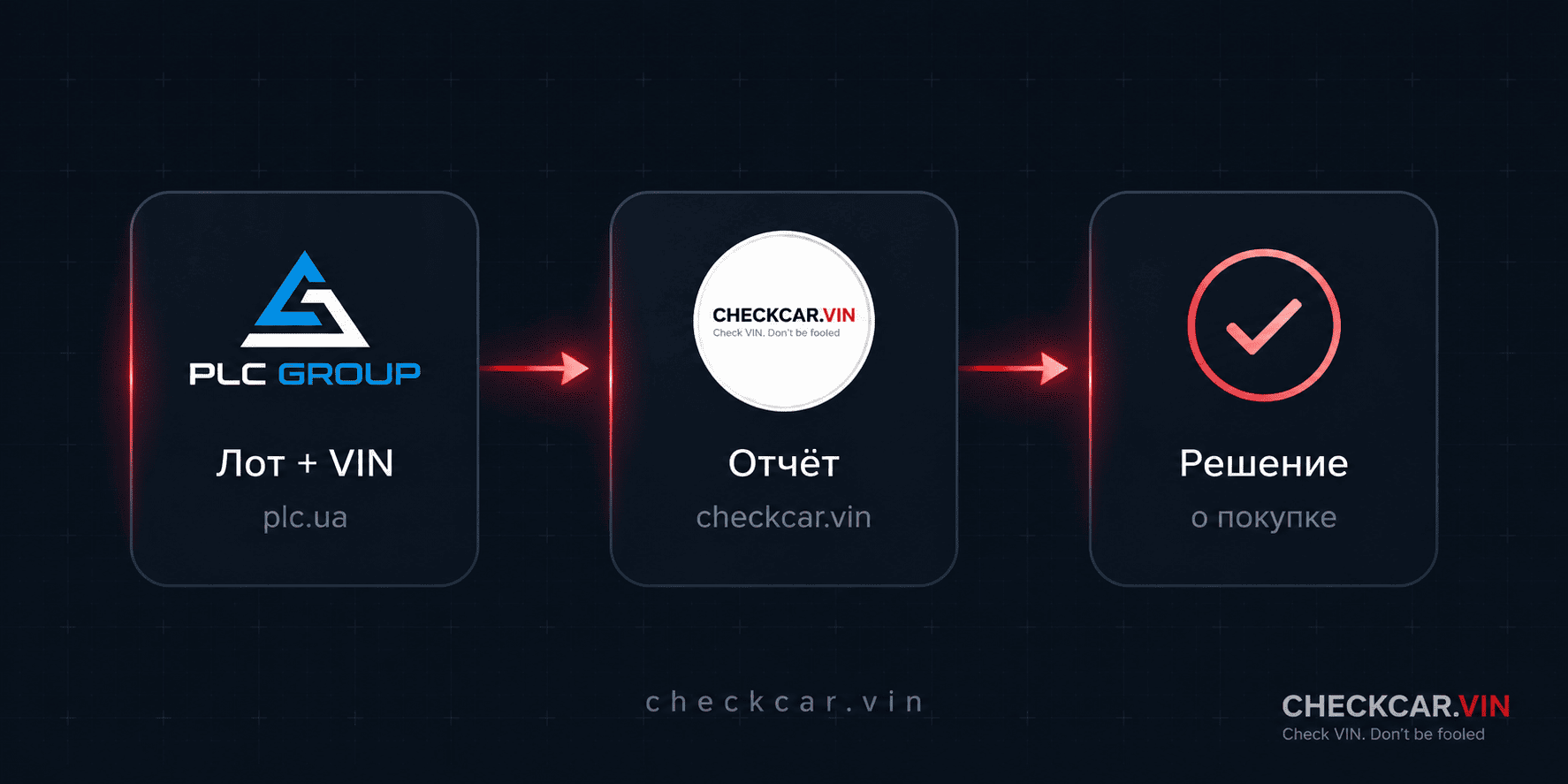
Step-by-step process:
- Find the vehicle lot you are interested in on plc.ua. The description of each vehicle includes a VIN number and a “Detailed VIN Report” button—click it.
- Go to checkcar.vin and pay for a report. You can choose a one-time report, a package of reports, or test the service before subscribing by using the 3-day trial period for UAH 49.99.
- Study the report carefully. Pay attention to the following sections:
- Mileage discrepancies
- Title status (Clean / Salvage / Rebuilt)
- Auction history (whether the vehicle was previously sold with damage)
- Accidents and insurance claims
- Liens and legal seizure
- Configuration and options (whether they match the seller’s description)
If no issues are found, place your bid. If you have any questions, consult with a PLC.ua online auction manager before buying a vehicle. If necessary, order an in-person inspection with a detailed report.
General Conclusions
Spending UAH 49.99 on a vehicle history check before placing a bid worth thousands is the cheapest insurance against major financial losses. In its reports, Checkcar.vin provides access to data from official databases (government and insurance sources) as well as commercial information sources. You will see the actual mileage, learn whether the vehicle has been involved in an accident, verify its title status, and receive information about liens and factory configuration.
Checkcar.vin pricing allows users to purchase a single report, buy report packages, or subscribe on a monthly basis (checkcar.vin subscriptions are especially beneficial for users who regularly verify large numbers of vehicles).
Checkcar.vin reviews demonstrate that the service helps buyers avoid transactions involving problematic vehicles. It is better to know the truth before purchase than to discover hidden damage or legal restrictions after the vehicle has already crossed the border.